Skip to content
Introduction
How does IPTV work? IPTV (Internet Protocol Television) delivers television content over the internet instead of traditional cable or satellite systems. Instead of broadcasting signals through antennas or coaxial cables, IPTV streams video using internet data packets. This allows users to watch live TV, on-demand content, and time-shifted programs through smart TVs, streaming devices, apps, or set-top boxes.
In this guide, you’ll learn the technology behind IPTV, how content is delivered, the benefits and limitations, and how it compares to cable and satellite—written clearly for U.S. audiences seeking accurate, unbiased information.
What Is IPTV?
IPTV stands for Internet Protocol Television.
It is a method of delivering television programming through internet networks using IP (Internet Protocol), the same system that powers websites and email.
Instead of receiving scheduled broadcast signals, users stream media through a broadband connection.
Key Components of IPTV
IPTV relies on several technical layers:
- Content acquisition (licensed TV channels or on-demand libraries)
- Encoding and compression (video converted to digital format)
- Content delivery network (CDN)
- Middleware (user interface and subscriber management)
- End-user device (Smart TV, streaming box, smartphone, etc.)
How Does IPTV Work Technically?
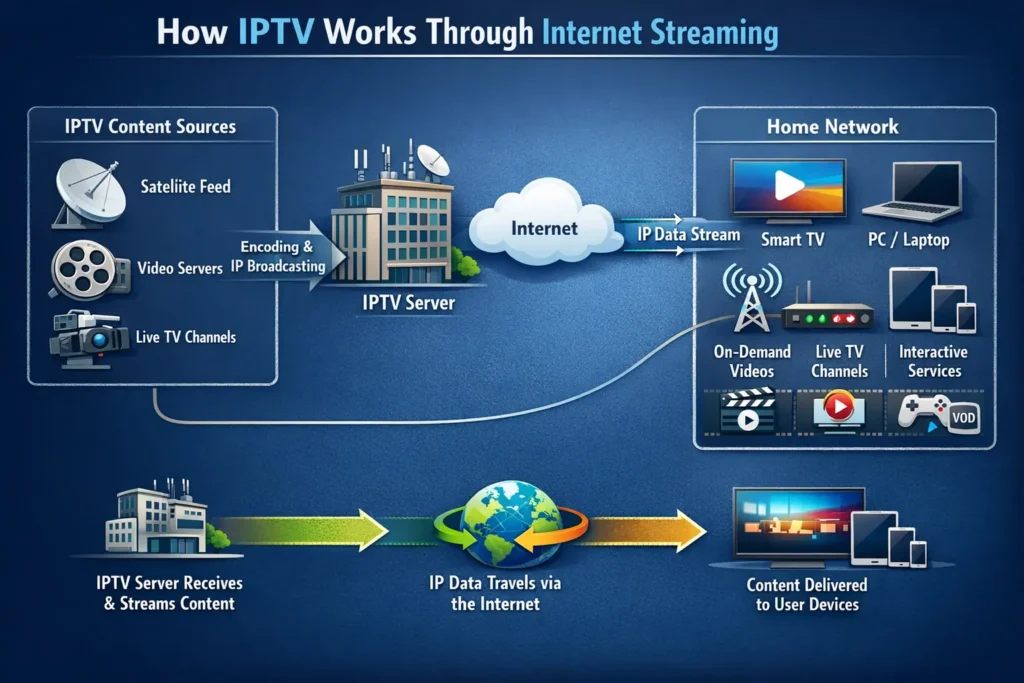
Short Answer (Featured Snippet Optimized)
IPTV works by converting television signals into digital data packets, transmitting them over the internet via a content delivery network, and decoding them on a user’s device for playback in real time or on demand.
Step-by-Step Process
1. Content Is Collected
Licensed broadcasters provide live or recorded content.
2. Encoding & Compression
Video is compressed using formats like H.264 or H.265 to reduce bandwidth usage.
3. Storage & Servers
Content is stored on secure servers or cloud infrastructure.
4. Delivery via IP Network
Data travels through a broadband internet connection instead of cable lines.
5. Device Decoding
Your IPTV app or device decodes the stream for display.
Types of IPTV Services
IPTV services generally fall into three categories:
1. Live Television
Real-time streaming of TV channels.
2. Video on Demand (VOD)
Users select content from a digital library.
3. Time-Shifted TV
Allows pause, rewind, or replay of previously aired content.
How Is IPTV Different from Cable or Satellite?
| Feature | IPTV | Cable TV | Satellite TV |
|---|---|---|---|
| Delivery Method | Internet | Coaxial cable | Satellite dish |
| On-Demand | Yes | Limited | Limited |
| Equipment | App/Box | Cable box | Dish + receiver |
| Internet Required | Yes | No | No |
| Flexibility | High | Moderate | Moderate |
IPTV provides greater personalization but depends entirely on internet quality.
Is IPTV Legal in the United States?
Yes, IPTV technology itself is legal. However, legality depends on whether the provider holds proper distribution licenses.
According to the U.S. Copyright Office (copyright.gov), distributing copyrighted content without authorization violates federal law.
The Federal Communications Commission (FCC) (fcc.gov) regulates communications networks but does not license IPTV providers directly.
Users should verify that services operate with legitimate broadcasting rights.
For consumer guidance, refer to:
- U.S. Copyright Office – https://www.copyright.gov
- Federal Communications Commission – https://www.fcc.gov
- Federal Trade Commission – https://www.ftc.gov (consumer protection)
What Internet Speed Do You Need for IPTV?
Recommended Speeds
- SD streaming: 5 Mbps
- HD streaming: 10–15 Mbps
- 4K streaming: 25 Mbps or higher
A wired Ethernet connection typically provides better stability than Wi-Fi.
Benefits of IPTV
IPTV offers several advantages:
- Flexible device compatibility
- On-demand viewing
- Multi-device streaming
- Personalized recommendations
- Interactive features
It integrates well with smart home ecosystems.
Limitations and Risks

IPTV also has constraints:
- Requires stable internet
- Buffering during congestion
- Potential service interruptions
- Quality varies by provider
- Legal risks if unlicensed
Consumers should research providers carefully.
Common Mistakes People Make About IPTV
1. Assuming All IPTV Services Are Legal
Not all providers have proper content licenses.
2. Ignoring Internet Requirements
Slow connections cause buffering.
3. Using Public Wi-Fi for Streaming
Security risks increase.
4. Not Checking Device Compatibility
Some apps don’t support all smart TVs.
How Does IPTV Work with Smart TVs?
Most smart TVs support IPTV through apps installed from official app stores. Users log in using subscription credentials, and content streams directly over Wi-Fi or Ethernet.
People Also Ask
How does IPTV work without cable?
IPTV streams content through an internet connection instead of physical cable infrastructure.
Does IPTV use a lot of data?
Yes. HD streaming can use 3–5 GB per hour. 4K may use up to 7–10 GB per hour.
Is IPTV better than cable?
It depends on user needs. IPTV offers flexibility; cable may offer more consistent uptime.
Can IPTV work on any TV?
Any TV with HDMI support can use IPTV via a streaming device.
Internal Linking Opportunities
If building a content cluster, consider linking internally to:
- “Is IPTV Legal in the US?”
- “Best Devices for IPTV”
- “How to Set Up IPTV on Smart TV”
- “IPTV vs Streaming Services Comparison”
This strengthens topical authority.
Frequently Asked Questions (Short Answers)
1. How does IPTV work in simple terms?
IPTV sends TV programs through internet data instead of traditional broadcast signals.
2. Do you need special equipment for IPTV?
Usually a smart TV, app, or streaming device with internet access.
3. Is IPTV the same as Netflix?
No. IPTV may include live TV; Netflix is on-demand only.
4. Can IPTV work without Wi-Fi?
No. IPTV requires an internet connection.
5. Is IPTV safe to use?
Licensed IPTV services are safe. Unlicensed services carry legal and security risks.
6. Why does IPTV buffer?
Buffering usually results from slow internet or server congestion.
Conclusion

Understanding how IPTV works helps consumers make informed decisions about modern television delivery. IPTV uses internet protocol networks to stream live and on-demand content efficiently, offering flexibility and personalization. However, service quality depends heavily on internet stability and proper licensing.
By focusing on legitimate providers, secure connections, and adequate broadband speeds, users can safely benefit from IPTV technology. As streaming continues to evolve, informed choices remain essential for long-term reliability and compliance.